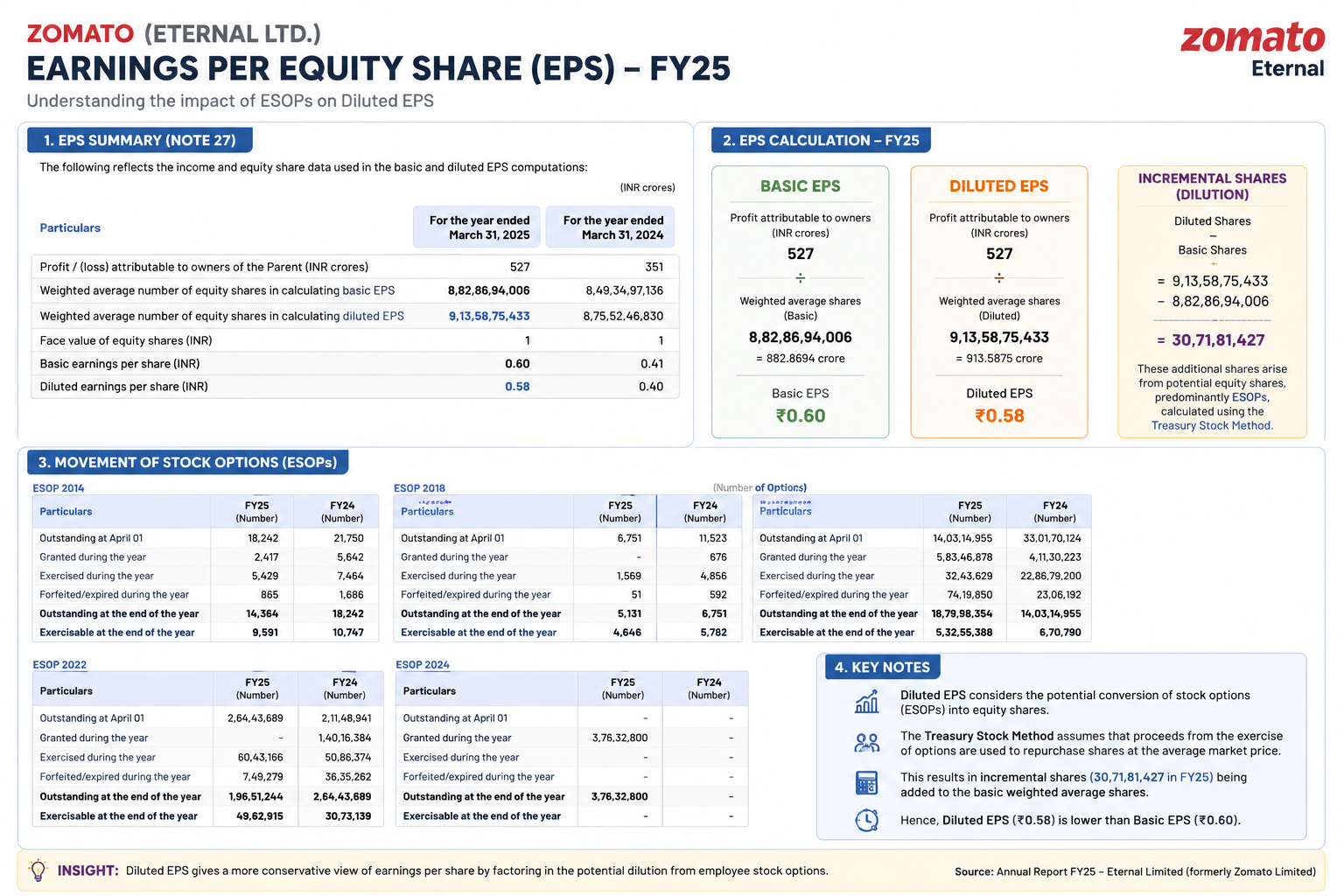
While studying EPS, I decided to move beyond formulas and calculate it using a real company.
I picked Zomato (now Eternal Ltd.).
According to the FY25 annual report:
- Profit attributable to shareholders = ₹527 crore
- Basic weighted average shares = 882.87 crore
- Diluted weighted average shares = 913.59 crore
This gives:
- Basic EPS = ₹0.60
- Diluted EPS = ₹0.58
The difference between the basic and diluted share count is 30.72 crore shares.
My first thought was that these additional shares must be coming from ESOPs. So, I went through the share-based payment note and found multiple ESOP schemes, including ESOP 2021, ESOP 2022, and ESOP 2024.
However, I soon realized that diluted EPS is not calculated by simply adding all outstanding options to the share count.
As I dug deeper, I came across the Treasury Stock Method, which is used to calculate the impact of employee stock options on diluted EPS.
Under this method, it is assumed that employees exercise their stock options and the company receives cash equal to the exercise price. The company is then assumed to use this cash to buy back its own shares from the market. As a result, only the net increase in shares, known as incremental shares, is added to the diluted share count.
In simple terms:
- Employees exercise stock options.
- The company receives cash from the exercise price.
- The company uses that cash to repurchase shares from the market.
- The repurchased shares reduce the potential dilution.
- Only the remaining incremental shares are included in diluted EPS.
Although I have not yet fully reconciled Zomato’s 30.72 crore incremental shares, this exercise taught me an important lesson.
Calculating Basic EPS is straightforward.
Understanding Diluted EPS requires understanding employee stock options, potential dilution, weighted average shares, and the Treasury Stock Method.
Sometimes the most valuable learning comes not from finding the answer immediately, but from investigating where the numbers come from.
The content published on this blog is intended solely for educational and learning purposes. The views expressed are my personal interpretations based on publicly available information such as annual reports, investor presentations, earnings calls, regulatory filings, and other publicly disclosed sources. Nothing on this blog should be construed as investment advice, financial advice, research recommendations, or a solicitation to buy or sell any security. Readers should conduct their own research and consult qualified financial professionals before making any investment decisions.